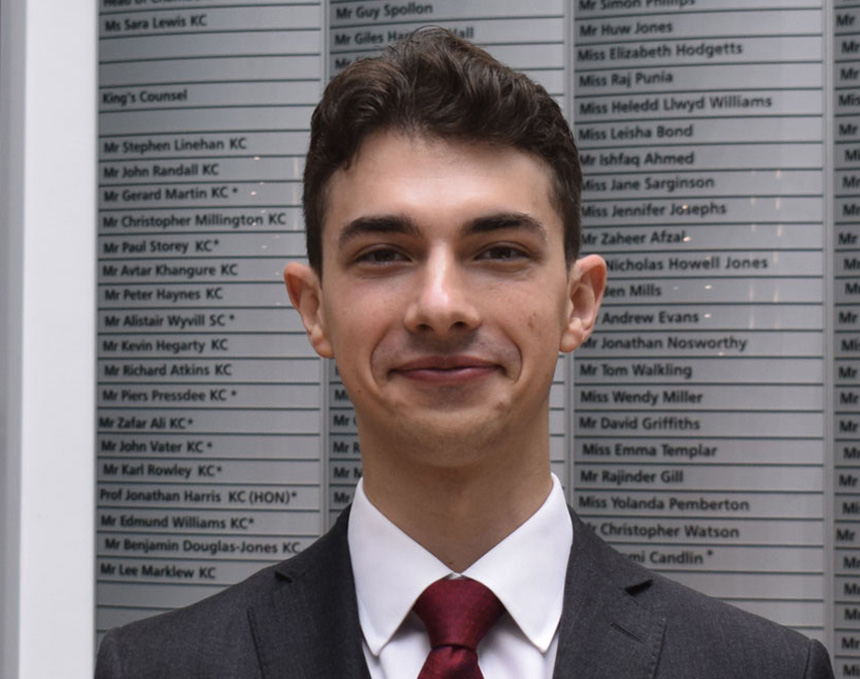
Introduction
Connor maintains a busy multi-disciplinary practice. Connor is a trusted advocate, who is regularly instructed to advise and represent his clients from the outset of proceedings until judgment in the High Court, County Court and Employment Tribunals. Connor’s principal areas of practice include:
- Employment
- Trade Union Disputes
- Commercial
- Employment and Non-Employment (civil) Discrimination
- Civil Litigation
- Personal injury and Clinical negligence
- Torts not involving personal injury
- Costs
Connor’s Clients say:
- “[I]t was clearly down to [his] forensic cross examination that we have our helpful findings on pay, holiday and contributory conduct”
- “I do love [his] attention to detail”
- “[Connor] is fantastic”
- “[We] have been really impressed with Connor. He’s been very responsive and has given clear advice.”
- “[Connor] has been brilliant”
Before joining the Bar, Connor taught Employment Law and Commercial Law at Durham University, where he also completed his master’s thesis. He later gained further experience as a County Court advocate, acquiring substantial advocacy experience in interim hearings, contractual disputes, personal injury, and fixed costs disputes.
Connor particularly enjoys working with clients from an early stage to ensure the best possible outcome. He offers a detail-oriented approach to his cases, leaving no stone unturned.
Outside of his practice, Connor enjoys bouldering, cooking and expanding his vinyl record collection.
Employment and Discrimination Disputes
Connor prides himself on working closely with clients to ensure that the best outcome is achieved for their needs. He aims to provide bespoke solutions and detail-oriented advice and advocacy. He regularly represents clients at every stage of proceedings, from pleadings to final hearings.
Connor has successfully advised and represented a broad range of claimants and respondents in the Employment Tribunal. Connor’s concurrent experience in the County Court and High Court makes him well-placed to assist in relation to multi-disciplinary disputes. He regularly represents clients in the Employment Tribunal and civil courts concerning issues surrounding civil restraint and vexatious litigants, personal injury, data protection, and contractual disputes. Connor also regularly represents clients in relation to allegations of non-employment discrimination and breaches of contract in the civil courts.
Connor’s recent Employment Tribunal cases include:
- Successfully representing a respondent NHS Trust in a disability discrimination and whistleblowing dispute that was listed for 10 days. All of the claimant’s claims were dismissed;
- Successfully representing a respondent medical provider in an unfair dismissal and race discrimination dispute, over 4 days. All of the claimant’s claims were dismissed;
- Representing the Claimant in a 3-day unfair dismissal dispute arising from his alleged redundancy following a TUPE transfer;
- Representing the respondent in a complex 5-day unfair dismissal final hearing, arising from the claimant’s alleged theft and fraud;
- Successfully representing an executive claimant in an unfair dismissal dispute. The dispute turned on issues of continuity of service across varied executive positions and several companies in different jurisdictions, which were found to be under the effective control of the respondent;
- A 6-day hearing on behalf of an NHS Trust respondent, concerning failure to make reasonable adjustments and constructive unfair dismissal;
- Achieving a favourable outcome following a 5-day hearing on behalf of a respondent school. The dispute concerned allegations of disability discrimination, unlawful deductions of wages and breach of contract spanning several years, and constructive unfair dismissal;
- Successfully representing the respondent in a 3-day whistleblowing dispute
- Successfully representing the respondent, a social care provider, in an unfair dismissal claim;
- Successfully representing the respondent, a local authority, in a 6-day dispute concerning failure to make reasonable adjustments during a job application process;
- Successfully seeking dismissal of a claim for failure to comply with time limits, at a preliminary hearing.
Connor is well-versed in handling vexatious litigants. He has recently appeared as the sole junior in the High Court in an employment-related Extended Civil Restraint application on behalf of six public-sector claimants, led by Elizabeth Hodgetts. Connor has also recently managed a High Court dispute, unled, on behalf of the Defendant. Connor ensured that the claim against his client, which alleged that a COT3 settlement agreement was entered into without capacity, was struck out with a substantial costs order. The court also granted a Civil Restraint Order in favour of his client.
Connor has acted for and advised clients in industries such as nursing, pharmacies, social care, education and higher-education, banking, and logistics, among others. Connor represents clients with respect to roles of all seniorities, including, recently, a Chief Operating Officer.
Commercial
Connor is a seasoned commercial lawyer in matters both related and unrelated to employment disputes. His work is based on strong academic foundations, having taught Commercial Law at Durham University before coming to the Bar. Connor has a proven track record as sole counsel, and has robust expertise in the operation of the Civil Procedure Rules. Most recently, Connor’s cases include:
- Obtaining a Civil Restraint Order, strike out, and indemnity costs in the High Court against a Claimant who alleged that he lacked capacity to enter into a settlement agreement in previous proceedings;
- Representing claimants and defendants in b2b contractual disputes worth in excess of £100,000;
- Allegations of misrepresentation;
- Allegations of unjust enrichment;
- Disputes arising out of consumer contracts;
- Successfully representing claimants and defendants in injunction proceedings in the High Court. Connor recently advised on a representative (group) civil harassment injunction on behalf of every employee of a business.
By nature of his expertise in employment law and commercial law, each in their own right, Connor is particularly well-placed to represent clients in civil matters that arise from an employment relationship.
Costs
Connor is an affiliate member of the Association of Costs Lawyers. He accepts instructions across the full range of specialist costs disputes. During his pupillage, Connor gained specialist experience in costs disputes in the County Court and the Employment Tribunal. He was involved in detailed assessment proceedings, costs applications, and other disputes arising from points of law.
Connor’s experience includes:
- Drafting retainers;
- Retainer issues, including CFA disputes and Mazur-related matters;
- Claims concerning the recovery of solicitors’ fees;
- Detailed assessment proceedings and solicitor-client costs assessments;
- Disputes surrounding the application (and dis-application) of the fixed costs regimes, past and present;
- Qualified One Way Costs Shifting;
- Issues arising out of allocation to the Fast Track and Intermediate Track;
- Budgeting and Costs and Case Management Conferences, allocation, and interim hearings;
- Wasted costs orders.
Connor has a busy courtroom practice and routinely advises and appears for clients in primary proceedings and related costs applications, in addition to costs-only disputes. For example, Connor’s recent cases have included:
- Successfully advising his client in an inter-partes dispute arising from inter alia the alleged unauthorised conduct of litigation by a Grade-D fee earner, following the decision in Mazur & Anor v Charles Russell Speechlys LLP.
- Redrafting a firm’s retainer with respect to non-contentious work;
- A claim against a client for recovery of solicitor’s costs, in which the client counterclaimed in professional negligence;
- Successfully representing a paying party in a complex costs-only dispute concerning the interplay between CPR Part 36, fixed costs, and disposal hearings;
- Solicitor-client detailed assessment proceedings on behalf of the receiving party;
- Appearing for a solicitor in a dispute about its own-client costs, resulting in a complete recovery.
Previously, during his time as a paralegal, Connor assisted with an appeal to the Court of Appeal concerning the rights of beneficiaries of a will to challenge solicitors’ fees.
More broadly, Connor advises and represents clients in commercial matters arising out of contracts, data protection, nuisance and negligence.
Trade Union Law
Connor is increasingly instructed to act on behalf of Trade Unions in employment disputes. Connor is versed in the goals and needs of Trade Unions, including the merits of litigation for the benefit of all Union members. He is pleased to advise and represent Trade Unions in strategic litigation in the Employment Tribunal and beyond.
Examples of Connor’s recent cases include:
- A dispute concerning allegations of Trade Union detriment, arising from the Claimant taking a concurrent position as a Trade Union Official
- Allegations of failure to inform and consult a group of 150 Union members during a TUPE transfer.
Personal Injury, Clinical Negligence and Torts
Connor regularly advises and represents claimants and defendants in the High Court and County Court. He has a range of experience, including clinical negligence, claims brought under the Human Rights Act 1998, psychiatric injury, workplace stress, and occupiers’ liability. He is at-home in personal injury disputes concerning fraud and Fundamental Dishonesty.
Connor’s recent cases include a Multi-Track case concerning an allegation of abuse by a protected party with dementia. Connor represented the claimant, whose life had been shortened as a result of the abuse. Connor has also recently acted for the claimant in a Multi-Track employers’ liability dispute that arose from a crush injury to her hand.
Connor has a growing practice in clinical negligence and related torts. Connor has notably represented a Defendant NHS Trust in clinical negligence proceedings in the High Court which, in part, arose out of Articles 2, 3 and 8 ECHR. Connor has also advised on, and appeared unled for the Claimant in a dental negligence dispute concerning the avoidable loss of all of the Claimant’s natural teeth. Connor has gained experience in drafting and advocacy arising out of clinical negligence disputes, and is familiar with the nuances of clinical negligence litigation involving private practitioners.
In addition to personal injury work, Connor also undertakes cases arising from torts that do not necessarily involve physical injury. His experience in this area includes:
- Data claims involving defamation, misuse of private information and the UK GDPR;
- Nuisance;
- Negligence;
- Civil Harassment;
- False imprisonment. Connor has acted for and against the police in related claims; and
- Misfeasance in Public Office.
Education
BPC, University of Law: Outstanding; top of class.
Master of Jurisprudence (by research), University of Durham: Pass Without Corrections
LLB (Hons), Law, University of Durham: 2:1
Selected Awards & Prizes
Gray’s Inn Lord Justice Holt Scholarship (BPTC)
University of Law, Birmingham: BPC Best Overall Student